Major insect pests of maize and their management
There are four
major pests of maize prevalent in India. These are spotted stem borer [Chilo
partellus (Swinhoe)], pink stem borer [Sesamia inferens Walker],
shoot fly [Atherigona spp.] and fall armyworm [Spodoptera
frugiperda (J. E. Smith)]. Integrated Pest Management (IPM) aims at
management of pests through a combination of techniques such as chemical,
biological, new cropping system, modification of cultural practices, use of
resistant varieties and through mechanical methods. The major pests and IPM is
described here.
1. Spotted Stem borer, Chilo partellus
(Swinhoe)
Features of Identification
Spotted stem borer (Chilo
partellus)is the most important insect pest of during Kharif season causing
yield losses in the range of 26-80%in different agro-climatic regions of India. Eggs
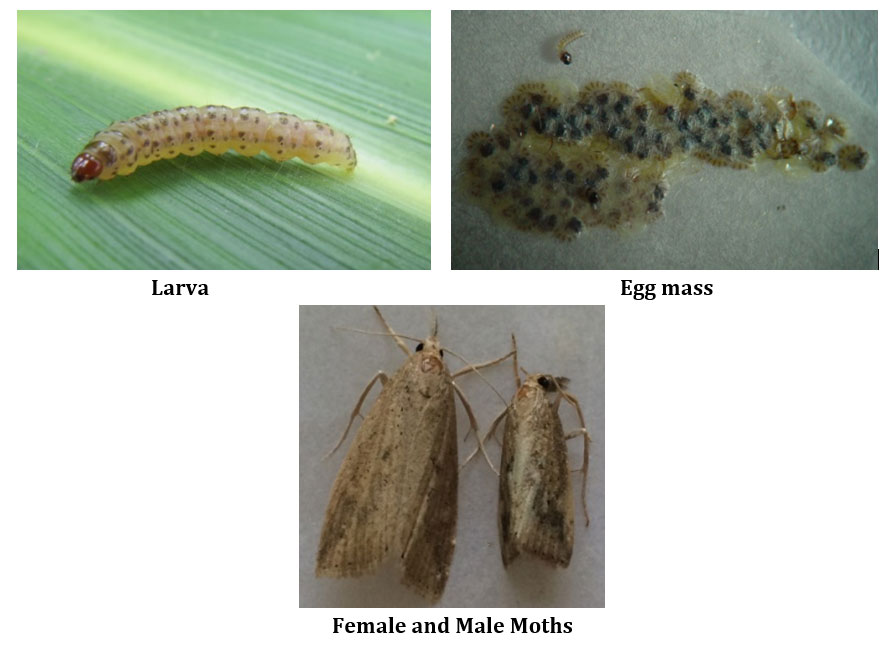
are flat, oval, yellowish and are laid in overlapping clusters. The larva is creamy
pink to yellowish brown with 4 rows of dotted stripes along the back with reddish
brown head. The larval period is completed in about 14-28 days. The forewing of
adult female moth is brown-yellowish with darker scale patterns forming longitudinal
stripes. In male moths, hind wings are pale straw-colour, and in females, they are
white. The life cycle is completed in about 5-6 weeks.
Nature of Damage
Adult of moth of spotted stem borer prefers 3-5
leaf stage maize for egg laying. Eggs are generally laid on lower surface of leaves.
Eggs hatch in 3-4 days and the newly hatched larvae crawl inside the leaf whorl and
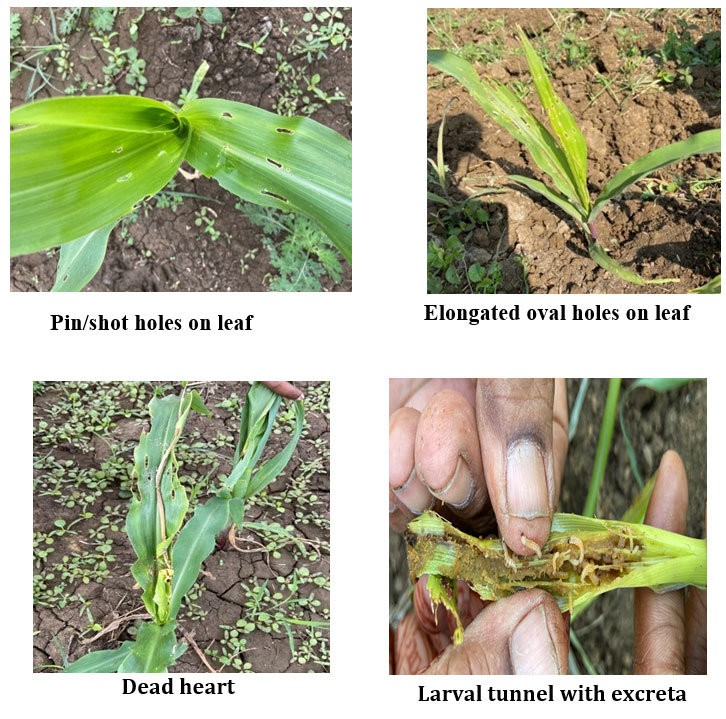
feed in groups. When the rolled leaves of whorl unfurl series of pin holes and
papery windows are visible, which is the first symptoms of spotted stem borer
attack. After a week onwards, larvae move out of whorl and bore upwards the
developing stalk, often reaching meristem.When
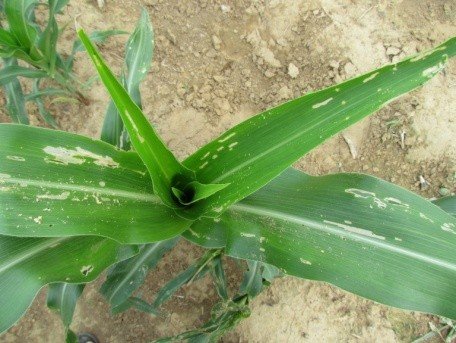
meristem is fed upon, the leaf whorl dries up known as ‘dead heart’ and the plant usually dies and often gives rise to tillers.
Integrated Pest Management
- Collection and destruction of the stubbles.
- Deep summer ploughing (not recommended under conservation agriculture)
- Planting of Napier grass in the boundary as a trap crop.
- Inter-crop maize with cowpea in 2:1 ratio.
- Two releases of Trichogramma chilonis 8 cards/ha (1,50,000 parasitized eggs/ha) at 7 and 15 days after germination.
- Remove and destroy dead hearts
- When infestation crosses 10%, spray Chlorantraniliprole 18.5 SC @150ml/ha
Natural Enemies
Egg parasitoid: Trichogramma
chilonis
Larval parasitoid: Cotesia
flavipes
Pupalparasitoid: Xanthopimla stemmator, Tetrastichus
howardii
Predators: Chrysoperla carnea, coccinellid, spider,
ear wig, dragon fly, preying mantid, Pentatomid bug, reduviid bug, robber fly, rove
beetles, wasp, king crow.
2. Pink stem borer, Sesamia
inferens Walker
Features of Identification
Pink stem borer is the most important
pest during Rabi season (winter) causing yield losses in the range of 25.7-78.9%.
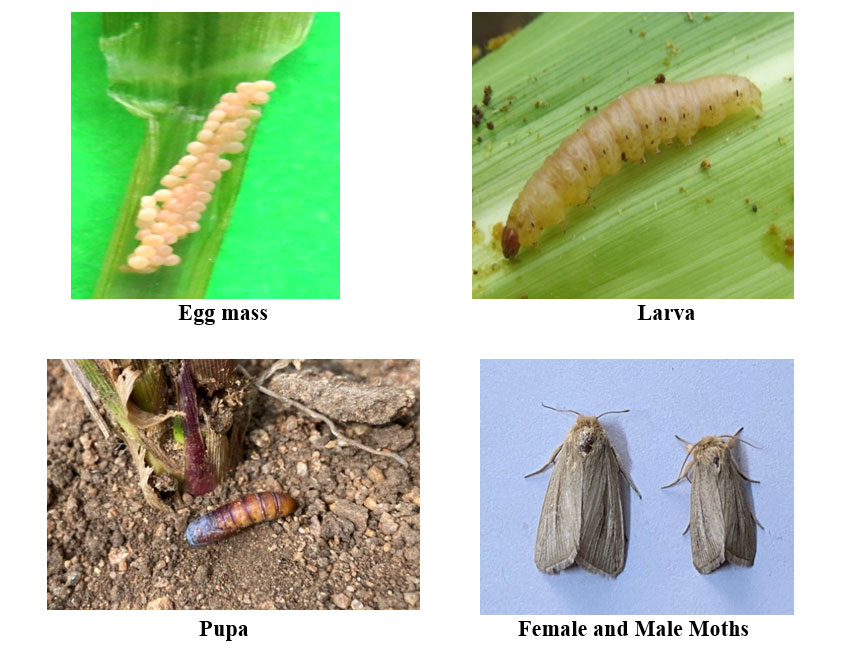
Eggs are creamy white, bead-like laid in 2-4 longitudinal rows inside the sheath of
1-2 lower leaves. Larva of this pest is light pink in color with a purplish tinge.
The larval period varies from 22-36 days. The adult female is medium sized, stout
straw coloured moth coppery tinged shining scales with brown streaks. Forewings have
three small black dots on the dorsal side and an intermediate brown strip. Hind
wings are white in colour. The antennae were pectinate in males and filiform
in female moths. The total life cycle varies from 40-53 days.
Nature of Damage
On hatching, pink borer larvae feed in
concealment inside the leaf sheath in groups and feed on the epidermal layer of the
leaf sheath preferably on first three leaf sheaths.The larva bore into the central
shoot resulting in drying up of growing point and formation of dead heart in young
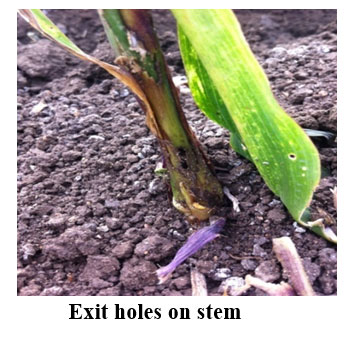
plants. The larva form circular shaped tunnels inside the stem and exit holes at the
surface. The tunnels are filled with excreta. Sometimes circular ring like cuts on
lower inter nodes will be observed due to larval feeding.
Management
- Collection and destruction of the stubbles
- Deep summer ploughing (not recommended under conservation agriculture)
- Removal and destruction of dead hearts.
- When infestation crosses 10%, spray chlorantraniliprole 18.5 SC @150ml/ha
Natural Enemies
- Egg parasitoid:Trichogramma chilonis
- Larval parasitoid: Cotesia flavipes
- Predators: Chrysoperla carnea, coccinellid, spider, ear wig, dragon fly, preying mantid, Pentatomid bug, reduviid bug, robber fly, rove beetles, wasp, king crow.
3. Fall Armyworm, Spodoptera frugiperda (J. E. Smith)
Features of Identification
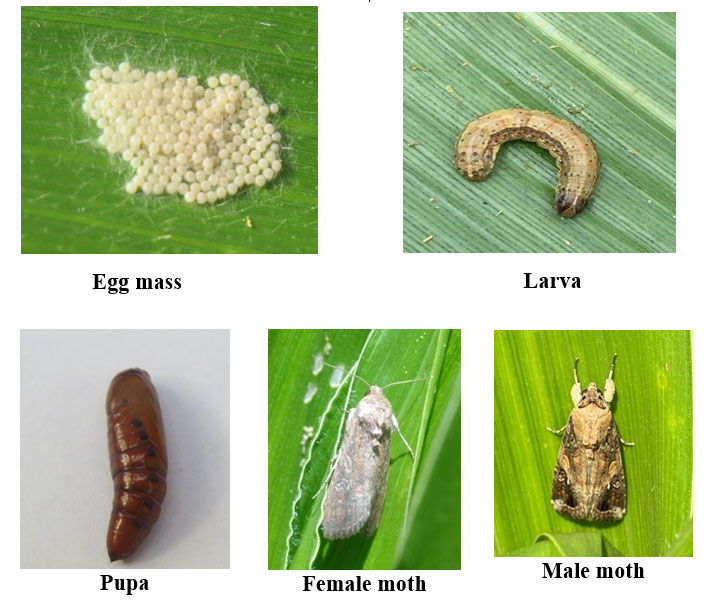
Fall armyworm (FAW) is an invasive insect pest causing serious damage to maize at all stages of its growth.It was first reported in India in May, 2018. The female moths lay egg masses on upper or under side of the leaf and covered with tan coloured scales. Each egg mass contains 50-150 eggs. Incubation period varies from 4-5 days. The larvae are smooth-skinned and vary in colour from light tan or green to dull grey body with three creamy yellow dorsal and lateral lines. The larva contains reddish brown head with predominant white, inverted Y-shaped suture between the eyes. The larva contains 6 instars in which the larval period varies from 15-18 days. On 8th and 9th abdominal segment, four large spots are arranged in a square shape on segment 8 and in trapezoid pattern on segment 9. Pupa is reddish brown in color. After 7-9 days, adults emerge from pupae. The forewing of adult male moth consists of fawn coloured spot and a white patch at the apical margin of the wing while female moths are less distinctly marked ranging from uniform grayish brown to a fine mottling of grey and brown. The total lifecycle completes in about 30-35 days which vary according to climatic conditions. Adult longevity varies from 4-7 days. The adult moth can fly up to 500 km before oviposition.
Nature of Damage
FAW attacks all stages of maize crop from
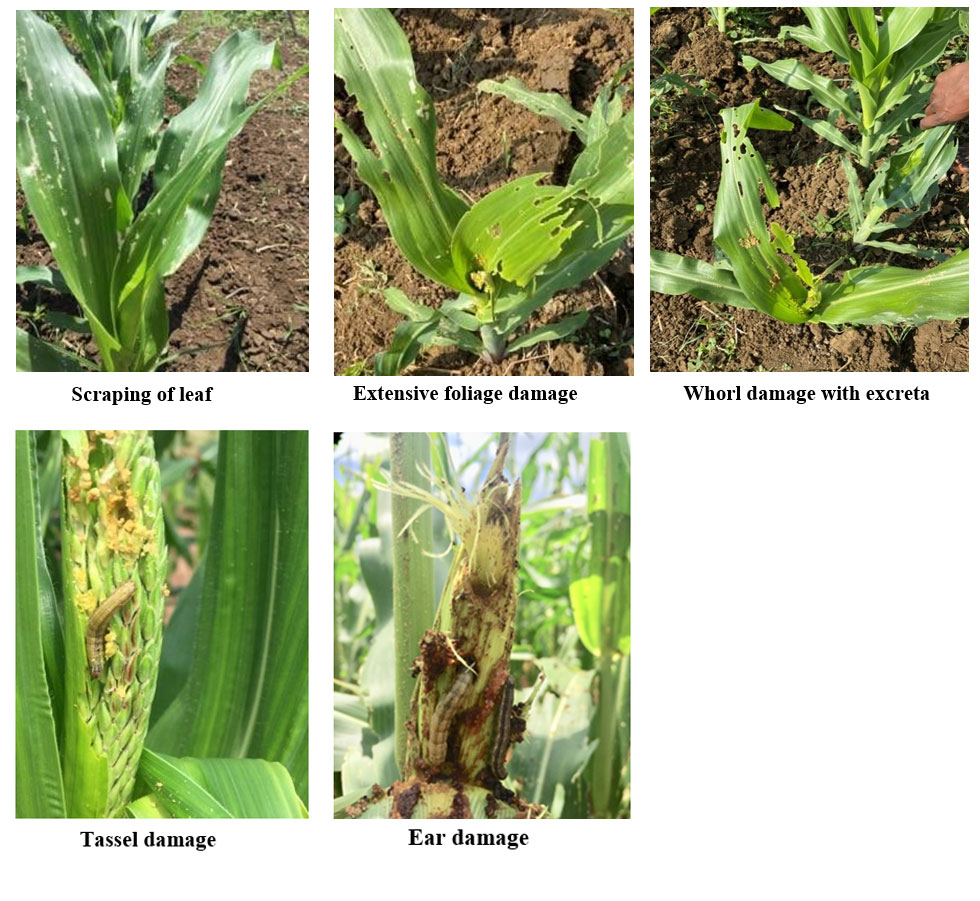
seedling emergence (V2) to ear development (R6). The young larvae of FAW feed in and
around the whorl leaves by scraping and skeletonizing the upper epidermis leaving a
silvery transparent membrane resulting into papery spots. The damage also results in
pinhole symptoms on the leaves. Older larvae remain and feed inside the whorl.The
damages by late instars (4th instar onwards) result in extensive
defoliation of leaves and presence of large amounts of faecal pellets in whorls.
Damage during vegetative stage leads to leaf damage but if damage happens during
reproductive stage it may damage tassels or may bore inside the corn ear and eat
away the kernels. The whorl damage by FAW results in significant yield losses while
ear feeding results in both quality and yield reduction.
Management
Based on available information, experimental findings
and expansion of label claims by CIB&RC, IPM strategies have been formulated and
has been upgraded from time to time.
Current IPM schedule, infestation
threshold for crop growth and spray schedule is given below:
Pre-planting practices
- Deep plough the fields to expose pupae to sun light and predatory birds (not recommended under conservation agriculture)
- Add neem cake @ 200kg/acre to the fields when maize is grown with zero tillage or wherever possible
- Maintain field bunds clean and plant flowering plantssuch as marigold, sesame, niger, sunflower, coriander, fennel etc. to attract natural enemies.
Sowing to six leaf stage
- Timely and uniform sowing over larger area
- Follow ridge and furrow planting method instead of flat bed sowing
- Apply only the recommended dosage of NPK as basal dose
- Seed treatment: Cyantraniliprole 19.8% + Thiamethoxam 19.8% FS @ 6 ml/kg of seed offers protection for 15-20 days of crop growth
- Plant 3-4 rows of napier grass/hybrid napieras trap crop around maize fields
- Intercrop maize with legumes, viz., pigeonpea, cowpea, black gram, kidney bean etc. in 2:1 to 4:1 ratio
- Erect bird perches @10/acre to encourage natural FAW predation by birds
- Install pheromone traps @ 4/acre soon after sowing and monitor moth catches#
- Adopt clean cultivation to eliminate possible alternate hosts
- Destruction of egg masses and larvae by crushing
- Application of sand or soil mixed with lime in 9:1 ratio into whorl of maize plants
- First spray should be with 5% neem seed kernel extract (NSKE)^ or azadiractin, 1500 ppm (1 litre/acre) @ 5ml /litreafter observation of one moth/trap/day or 5% FAW infestation on trapcrop or main crop
- If monitoring indicates more than one moth/trap/day install pheromone traps @ 15/acre for mass trapping [Note: For success of mass trapping go for community action] OR release egg parasitoids viz.,Telenomus remus @ 4000/ acre or Trichogramma pretiosum @ 16,000/acre. Two releases of parasitoids at weekly interval should be done. [Note: Release of parasitoids should not be opted if mass trapping is followed]
- At 5-10% infestation whorl application of Bacillus thuringiensis v. Kurstaki formulations (400g/acre) @ 2g/litre or Metarhizium anisopliae or Beauveria bassiana with spore count of1×108cfu/g (1 kg/acre) @ 5g/litre or SfNPV (600 ml/acre)@3ml/litre or entomopathogenic nematode (EPN) (4kg/acre) @20g/litre of water is recommended
- If infestation is more than 10%, whorl application of any one of the recommended insecticides for FAW, viz., Chlorantraniliprole 18.5 SC (80 ml/acre) @ 0.4 ml/litre; Thiamethoxam 12.6 % + Lambda cyhalothrin 9.5% ZC (50ml/acre) @ 0.25 ml/litre; Spinetoram 11.7 % SC (100ml/acre) @ 0.5 ml/litre; Emamectin benzoate5% SG (80g/acre) @ 0.4g/litre is recommended
Seven leaf stage to flowering
- Monitoring of FAW using pheromone traps @ 4/acres hould be continued#
- Spray 5% NSKE^ or azadiractin, 1500 ppm (one litre/acre) @5 ml /l after observation of one moth/trap/day or 5% of fresh FAW infestation
- If infestation is more than 10%, whorl application of Bacillus thuringiensis v. Kurstaki formulations (400g/acre) @ 2g/litre or Metarhizium anisopliae or Beauveria bassiana with spore count of1×108cfu/g (1 kg/acre) @ 5g/litre or SfNPV (600ml/acre)@3ml/ litre or entomopathogenic nematode (EPN) (4kg/acre) @20g/litre of wateris recommended
- If infestation is more than 20%, whorl application of any one of the recommended insecticides for FAW,viz., Chlorantraniliprole 18.5 SC (80 ml/acre) @ 0.4 ml/litre; Thiamethoxam 12.6 % + Lambda cyhalothrin 9.5% ZC (50ml/acre) @ 0.25 ml/litre; Spinetoram 11.7 % SC (100ml/acre) @ 0.5 ml/litre; Emamectin benzoate5% SG (80g/acre) @ 0.4g/litre is recommended.
Poison baiting is effective for late instar larvae and is optional. Mix 10 kg rice bran + 2 kg jaggery with 3 litres of water. Keep the mixture for 24 hours to ferment. Add anyone of the recommended insecticides mentioned above at their recommended dosages and 1 kg of sand just half an hour before application. Make into small pellets and apply into whorls of infested plants only. [Use hand gloves during mixing and application]
Flowering to harvest
- Hand picking and destruction of larvae boring into ears
- At 10% ear damage, application of Bacillus thuringiensis v. kurstaki formulations (400g/acre) @ 2g/litre or Metarhizium anisopliae or Beauveria bassiana with spore count of1×108cfu/g (1 kg/acre) @ 5g/litre or SfNPV (600ml/acre)@3ml/ litre or entomopathogenic nematode (EPN) (4kg/acre) @20g/litre of water is recommended.
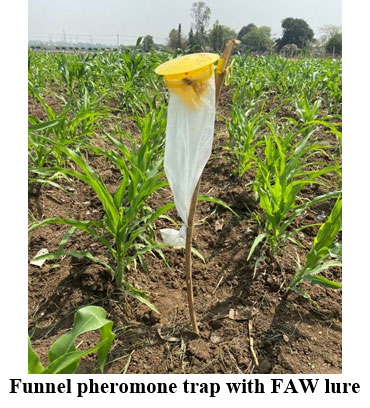
#Pheromone traps– Funnel trap with FAW lure should be installed at a height adjusted each week matching with crop canopy. Traps should be separated by a minimum distance of 75 feet. Observe traps for number of moths caught twice or once in a week and work out the catch/day.FAW lures should be changed once in 30 days in case of monitoring.
Preparation of Neem Seed Kernel Extract (NSKE) for one acre–10 kg of neem seed kernel is required for one acre. Grind 10 kg of need seed kernels to make powder. Soak the powder in 50 litres of water overnight.Stir and filter the contents using cotton cloth. Add 200 g detergent powder or 200 ml of soap solution to the filtered solution. Make up the volume to 200 litres by adding water.
Caution upon release of egg parasitoids– Minimum one week interval should be there between parasitoid release and application of neem or chemical insecticides
Precautions for pesticide use: Not more than two chemical sprays are to be used in entire crop duration. Same chemical should not be chosen for second spray. Sprays should always be directed towards whorl and applied either in early hours of the day or in the evening time. Use protective clothing, facemask and gloves during preparation and application of pesticides. Enter the field only 48 hours after spraying pesticide.Interval between application of chemical insecticide and harvest of corn should be minimum 30 days.
Natural Enemies
Egg Parasitoid: Trichogramma pretiosum,
Telenomus remus
Egg-larval Parasitoid: Chelonus sp
Larval
parasiotoid: Coccygidiumsp, Campoletis chloridae
Predators:
Predatory Pentatomid bugs, ear wigs
Entomopathogen: Nomuraea rileyi
4. Shoot fly (Atherigona soccata Rondani ; Atherigona
naqvii Steyskal)
Features of
Identification
Shoot fly, Atherigona spp. was reported to
be a serious pest in Spring maize which cause heavy plant loss if sown during third
week of February to first week of March. Spring maize is cultivated in North-Western
plain zone of India in the states of Punjab, Haryana, Uttarakhand and Uttar Pradesh.
Itwas reported to cause up to 60% plant loss and around 21% grain yield loss. The
species of Atherigona present in Punjab is A. naqvii whereas, the
region contiguous of Haryana, Delhi, Uttarakhand and Uttar Pradesh has a species
complex with A. soccata and/or A. orientalisin majority and A.
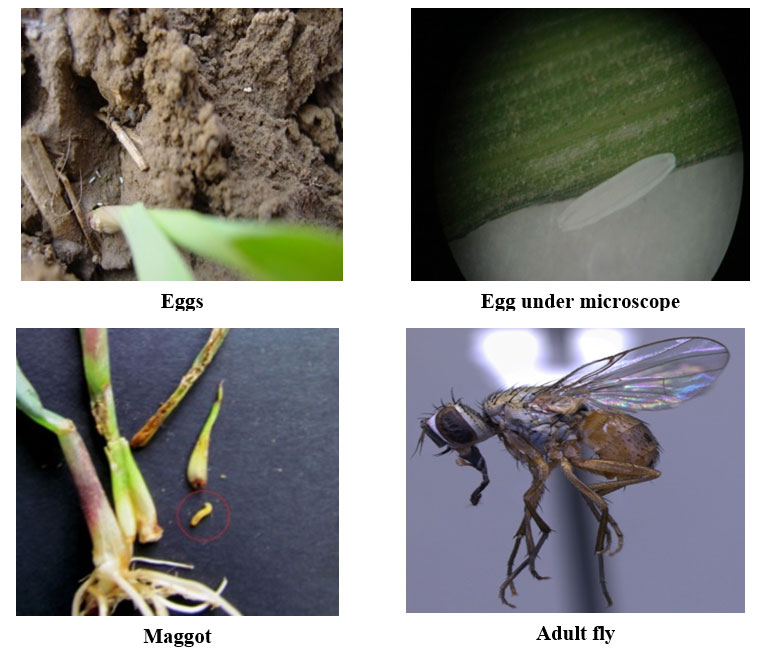
naqvii in minority,the proportion of which is yet to be resolved. Eggs of
A. soccata and A. orientalis are elongated like a small rice
grain, milky white in colour with two wing-like projections and those of A.
naqvii are cylindrical with fine ridges on surface. The incubation period
is 1-3 days. Larval period is 7-10 days with 3-4 instars. Full grown maggot is
yellow in colour. Pupation takes place inside the stem. The pupa is dark brown,
barrel-shaped. The pupal period lasts for about a week. The adult lives for 3-4
days. The life cycle is completed in about 3 weeks.
Nature of Damage
Atherigona spp. infests maize from 2
day old seedlings to three weeks after emergence by ovipositing of eggs on the
abaxial surface of basal leaves, shoot and in soil very close to base of the
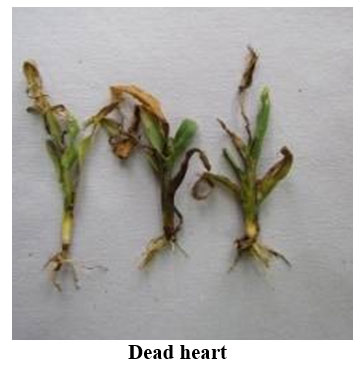
plant.Maggots bore into shoot while feeding, gradually killing the growing point
leading to withering of central shoot called dead heart, which is formed within two
weeks of germination.
Management strategies
- Sowing must be completed by first fortnight of February
- Seed treatment with imidacloprid 600 FS @ 6 ml/kg seed or Thiamethoxam 30 FS @ 8.0 ml per kg seed
- Removal and destruction of dead hearts
Natural enemies
Predators: Coccinellid, spider, robber fly,
pentatomid bug, ear wigs.
Minor pests of maize
Cob
borer [Helicoverpa armigera (Hubner) ]
Features of Identification
Helicoverpa armigera is an
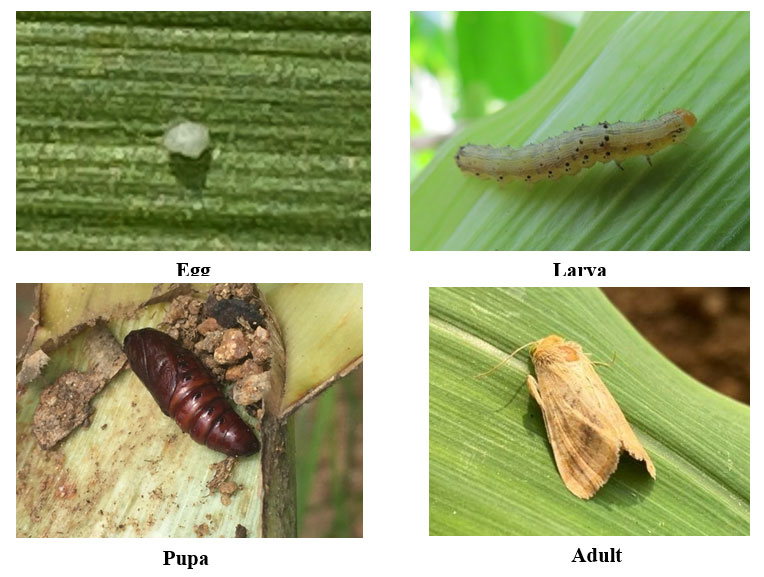
emerging pest of maize, especially in sweet corn. Eggs are spherical in shape and
creamy-white in colour, laid singly on silk. There are five or six larval
stages. The larva shows colour variation from greenish to brown. It has dark
brown-grey lines on the body with lateral white lines. Pupa is brown, rounded both
anteriorly and posteriorly, with two tapering parallel spines at posterior tip.
Forewings of adult moth contain line of seven to eight blackish spots on the margin
and a black comma-shaped marking in the middle underside of each forewing. There was
a distinguished colour pattern between male and female moths. The forewings of
males were greenish-grey in color which later faded to straw yellow while the hind
wings are cream to light yellow with dark brown outer marginal band. In case of
females, the colour of forewing were light brownwhile the hind wings were cream to
light yellow with pronounced dark brown bands. Females were also identified by the
presence of tuft of hairs on the tip of abdomen.
Nature of Damage
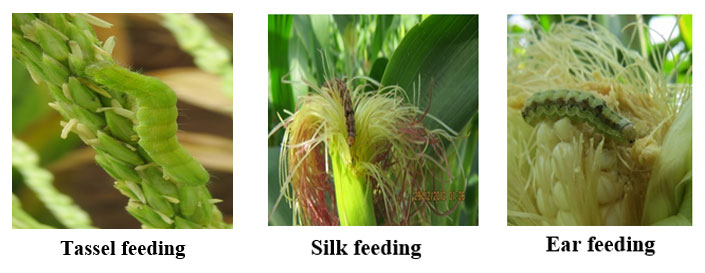
Larvae first feed on silk and may tunnel into
ears, especially if the ear tip is open and/or covered loosely.
Management strategies
- Cultivate sweet corn hybrids with husks well covering the ear-tip.
- Hand pick and destroy larvae before it enters inside the ear
- Installation of pheromone traps @4/ha for monitoring purpose
- Application of BtK formulations @ 2g/l or HaNPV @500LE/ha directed into ears if heavy infestation is noticed.
Natural enemies
- Egg parasitoid: Trichogramma chilonis
- Larval parasitoid:Campoletis chloridae, Bracon sp
- Predators: Chrysopids, Anthocoreids, coccinellids, pentatomid bugs, wasps, spiders
- Entomopathogens:Beauveria sp, Metarrhizium sp
Tobacco caterpillar [Spodoptera litura
(Fabricius)]
Features of
Identification
Spodoptera species are distributed throughout India.
Females lay eggs in masses of about 200 to 300 on the underside of leaves and
covered with brown scales. Eggs are laid in 2-3 layers. The larva is variable in
colour, sides of body with dark and light longitudinal bands; dorsal side with two
dark semilunar spots laterally on each segment, except for the prothorax; spots on
the first and eighth abdominal segments larger than others, interrupting the lateral
lines on the first segment. A bright-yellow stripe along the length of the dorsal
surface is characteristic of S. litura larva.
The larvae feed in group when they
are young but spread out as larvae grow. Grown-up larvae fell from plants pupate in
a small cell in the soil/cobs. In males, forewing contains reniform brown spot,
elongate orbicular spot, white fork in the median area, a row of dark brown glass
markings along outer margin and a large yellowish or light brown patch on the median
area adjacent to inner margin. The forewing of female moth is grey to reddish brown
with a strongly variegated pattern and paler lines along the veins. The hind wing is
greyish white with grey margins. The lifecycle takes about 25-30 days.
Nature of Damage
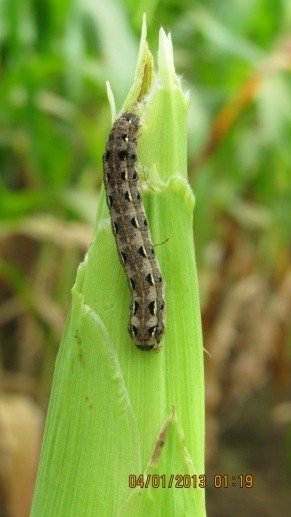
On hatching, the larvae feed on tender leaves in
groups. They scrape the surface but do not actually perforate it, creating a window
pane effect. Under severe infestation, the entire young plant may be consumed.Later
on they migrate and feed on the leaves which gives thin papery appearance.
Management
- Hand picking and destruction of larvae
- Installation of pheromone traps @10/ ha for monitoring purpose
- Release of egg parasitoid Telenomus remus @ 1,25,000/ha for 4 times at 7-10 days interval
- Application of NPV solution @ 500 LE/ha orneem formulations@ 5 ml/l ofwater can be done.
- Spraying of 5% neem seed kernel extract for the management of early instar larvae.
Natural enemies
- Egg parasitoid: Trichogramma chilonis, Telenomus remus
- Larval parasitoid: Apanteles sp, Bracon sp
- Predators: Reduviids, wasps, carabid beetles, lace wings, spiders
- Entomopathogen: Beauveria sp, Nomuraea rileyi
Pheromone trap specifications
TrapType: Funnel
shaped trap or sleeve trap.
Parts and dimensions of trap: Trap
to have three parts, viz., canopy, funnel shaped trap base and collection
device.
Canopy: Diameter: 140 mm.
Funnel:
Top Diameter: 110 mm; bottom opening: 30 mm
Ring diameter: 112
mm.
Collection device: Non collapsible polyethylene bag 0.33
gauge of length – 760 mm.
Trap material: Virgin plastic (No
reprocessed material to be permitted) (Yellow / Green color). Should withstand the
Sunlight, rain water and wind for 6 months (To be certified by Central Institute for
Plastic Engineering and Technology).
Installation: Install
within a week of sowing maize, ideally before germination. The height of the trap
should be adjusted every week matching the crop canopy.
Flower chafer
beetle [Chiloloba acuta (Weidemann); Oxycetonia versicolor
(Fabricius)]
Features of Identification
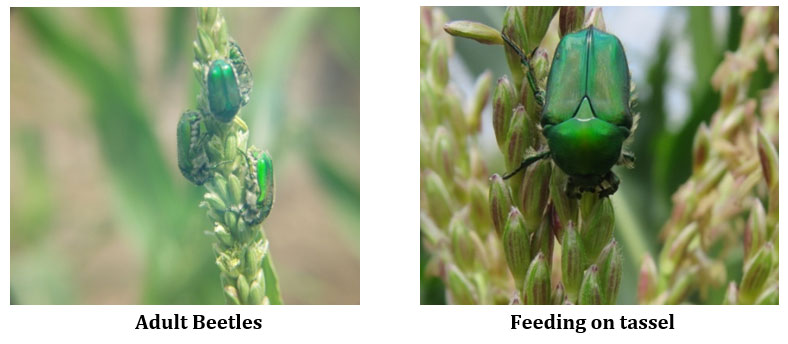
Chiloloba acuta adults are
bright metallic green in colour with prominent eyes and covered with yellow hairs
above and beneath . Females are bigger than males. The gravid females lay very tiny,
creamy white oval shaped eggs singly in soil. The larvae are dull white to greyish
white in colour, with posterior and anterior ends of the body equally broader and
feed on humus. There are three larval instars. Pupation takes place in soil by
constructing an earthen cage around them in the month of June. Pupa is yellow in
colour.
Nature of Damage
This pest is serious on maize at the time of
flowering. The adult beetles feed on the pollen and results in poor seed set.
Management
- Deep ploughing of infested field to kill the grubs in the soil.
- Hand picking of adults.
- Removal of dead decomposing matter in the nearby surroundings.
8. Army worm (Mythimna separata Walker)
Features of Identification
Eggs are shiny, greenish – white,
spherical with fine reticulations which turn black before hatching. The incubation
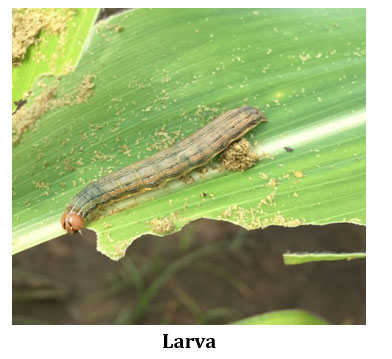
period is about 5 days. Mature larvae vary from greenish to greyish brown,
predominantly white inverted Y- shaped suture on the head and dorsal or sub dorsal
longitudinal light grey to black stripes or clear yellow stripes lines running
along the entire length of the body. The larval period is about 3 weeks. The larva
is found in the leaf whorl or at the surface of the soil. The pupa is dark brown in
colour. The pupal period is about 8 – 13 days. The adult moth is pale brown in
colour with dark specks. Hind wings are pale brown with dark external margin. Males
lack paired tufts on the basal segment of the abdomen below. The life cycle is
completed in one month. The alternate hosts arePaddy, wheat, sorghum, sugarcane,
oats, barley, bajra, ragi, legumes and some other grasses.
Nature of Damage
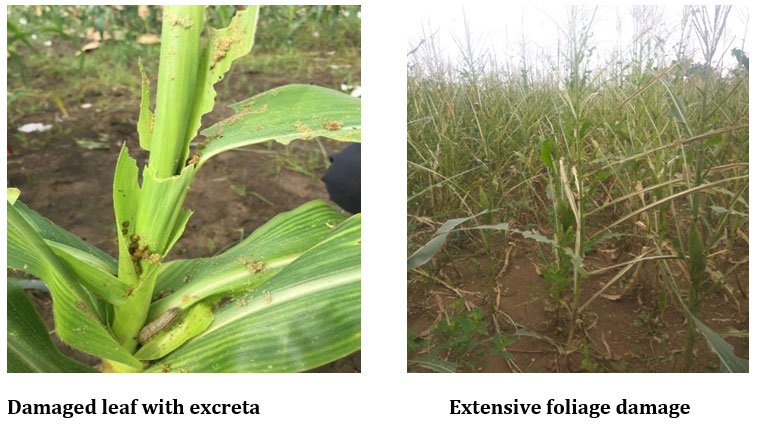
Plants are damaged by caterpillars. Larvae feed
on tender leaves and skeletonize them. In the case of severe attack, leaves
including midribs are eaten away and the fields look as if grazed by the cattle.
Larvae excrete faecal matter in the form of pellets which are seen in the plant
whorls. Larvae also damage immature ears. The incidence is more severe when good
rain follows dry period. The spring maize fields adjoin to wheat are more liable to
damage by this pest in northern India.
Management
- Hand picking and destruction of larvae.
- Spraying of emamectin benzoate 5 SG @0.5g/l of water for late instar larvae
- As the larvae are active at night, spraying in the evening is more advantageous.
9. Cut worm (Agrotis ipsilon Rott.)
Features of Identification
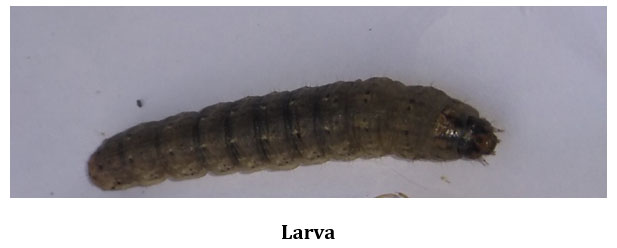
Females lay about 300 creamy white
dome-shaped eggs. Freshly hatched larva is slightly yellowish in colour with black
head. The full grown larva is greasy in appearance, plump and dark brown in colour
with red head. The larval period is about 4 – 5 weeks. The pupal stage lasts for
about 10 days. The pupa is reddish brown in colour and pupation takes place in
underground. Forewings of adults are long and narrow, darker than the hind wings and
marked with black dashes: the basal two-thirds of the forewing is dark, with the
outer third pale grey to brown; orbicular is tear-shaped; reniform has a distinct
black wedge- or dagger-shaped black marking on its outer margin. There is a zigzag
line of pale scales on a dark background in the sub terminal area. The antennae of
males are plumose (feathered), while the female antennae are filiform type.The life
cycle is completed in 8 – 12 weeks.
Nature of Damage
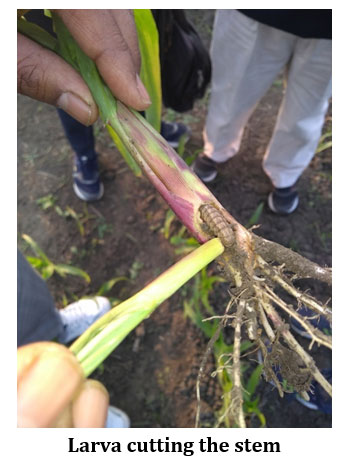
The larvae feed on leaves and also cut the
tender stems of young and growing plants either below the surface or above the
ground.
Management
- Digging near damaged seedlings and destruction of larvae.
- Hand picking of larvae by flash light.
10. Termites [Odontotermes obesus (Rambur)]
Features of Identification
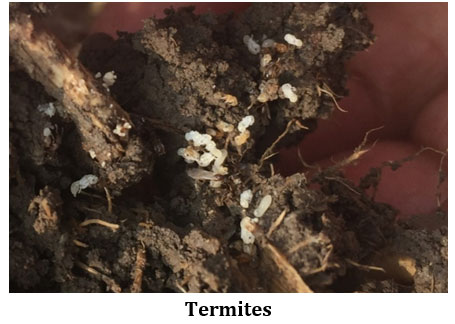
Termites are common throughout the
tropics and subtropics. The queen lays 70,000 to 80,000 eggs in 24 hours. The eggs
hatch after one week. Within 6 weeks, larvae develop to form soldiers or workers.
There is only one queen in the colony and normally lives for 5-10 years.The king’s
life is much shorter than that of queen and when he dies he is replaced by a new
one. The workers developed from fertilized eggs but remain stunted as they are
reared on ordinary food. The soldiers develop from unfertilized eggs and remain
comparatively under developed.
Nature of Damage
Termite invasion initiates from dry leaves.
Later roots as well as the lower part of the stem are destroyed resulting in
lodging. Vascular tissues might be damaged and wilting would occur especially
under water stress conditions. In extreme cases, the ears are invaded by
termites. Severely damaged plants may lodge and get completely destroyed by
termites.
Management
- Clean cultivation delays termite attack.
- Careshould be taken to avoid partially decomposed manure.
- Irrigation of field also reduce termite for a short period.
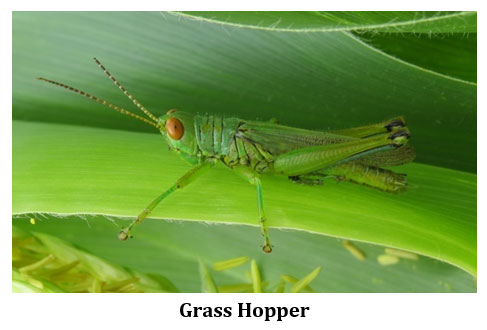
11. Grass Hopper (Hieroglyphus nigrorepletus Bol.)
Features of Identification
It is a sporadic pest
distributed all over India but more prevalent in Rajasthan. The alternate hosts are
sorghum, ragi, red gram, cotton, rice and other grasses. Eggs are laid in batches
under the soil (egg pods) consisting of 30 elongate eggs cemented together. Most
nymphs start feeding within one day after egg hatch, and usually feed on the same
plant as the adult. The nymphal stages require about 6 weeks. Total development
takes about 2.5 to 3.5 months.Adults live for 45 to 50 days.
Nature of Damage
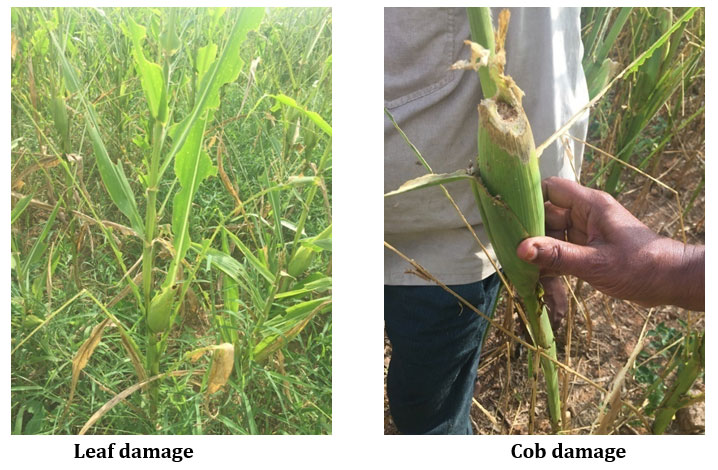
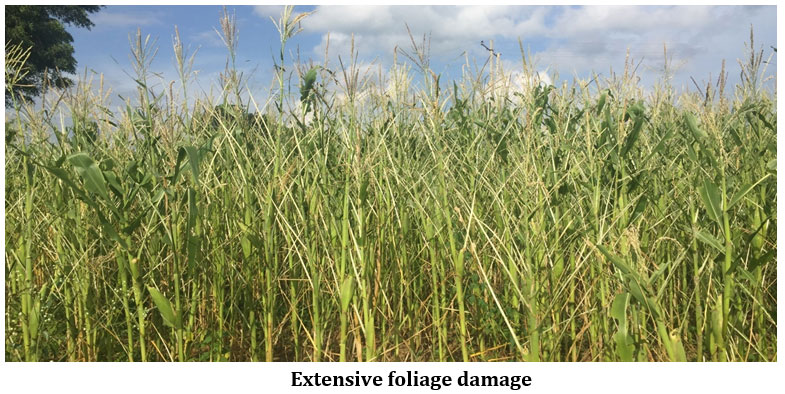
Injury may start at the leaf edge or in the
center of the leaf adjacent to the midrib. Defoliation is the primary injury to
plants, but damage often exceeds the amount of foliage eaten. Grasshoppers may feed
on ripening kernels of grain causing shattering. They also feed on the green silk,
preventing fertilization or filling of the ear.
Trimming sides of bunds and exposing egg masses for birds by summer ploughings.
12. Aphid [Rhopalosiphum maidis (Fitch)]
Features of Identification
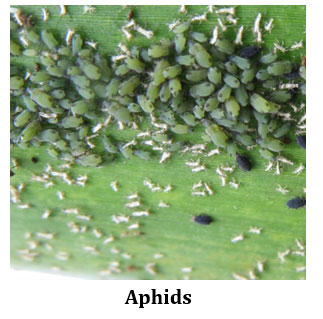
The aphids are bluish green, 2 mm
long, with black legs, antennae and cornicles. The females give birth to apterous
forms that moult four times to become adults. Under crowded conditions, or when the
host plants are under stress, aphids produce winged adults, which mould five times
to become adults. Nymphal development is completed in 12-15 days.
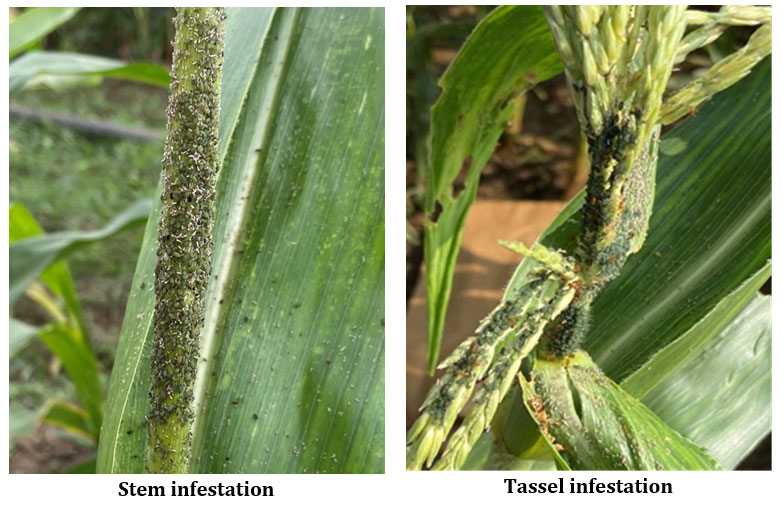
Nature of Damage
Aphid sucks the sap from the whorl leaves during
the vegetative stage of the crop. It also feeds on the panicles, and produces
honeydew on which sooty molds grow. It also transmits maize mosaic virus. However,
its infestations rarely reach damaging proportions. Damage may result in the
yellowing, tanning, and drying up of leaves. If young plants are infected they
seldom produce ears. The aphid colony may sometimes cover completely the emerging
tassels and the surrounding leaves preventing the emergence. Ears and shoots are
also infested and seed set may be affected. The tassel, if heavily damaged might
become sterile.
Management
- Mechanical removal of infested shoots.
- Conservation of natural enemies such as coccinellids, chrysopids and syrphids that are found to feed on the aphids which will reduce the population considerably without any insecticidal spray.
Natural enemies
Predators: Predatory Coccinellids, Anthocorid
bugs, mired bugs, syrphid/hover flies, green lace wings, spiders, wasps, rove
beetles.
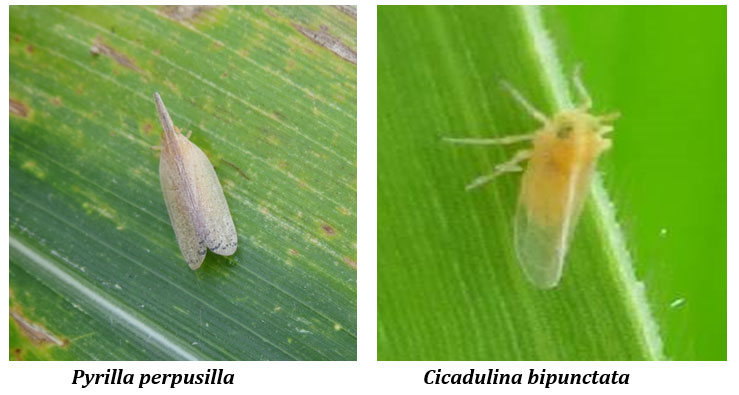
13. Leaf hoppers
[Pyrilla perpusilla (Walker)]
Cicadulina bipunctata (Motsumura)
Features of Identification Pyrilla adult females lay elongate pale white to slightly bluish eggs in loosely arranged elongated clusters of 20-50 which are covered by white waxy filaments of the caudal tuft. On hatching, nymphs emerge from eggs and start sucking the plant sap, developing to adult through five nymphal instars. The egg and nymphal stages occupies 7-12 days and 24-65 days respectively during April-October.
Management
- Avoid excessive use of nitrogen fertilizers.
- Conservation of adult nymphal parasitoid Epiricania melanoleuca.
Natural enemies
Nymphal Parasitoid: Epiricania
melanoleuca
Predators: Anthocoreids.
STORED GRAIN PESTS
14. Rice weevil (Sitophilus oryzae L.)
Features of Identification
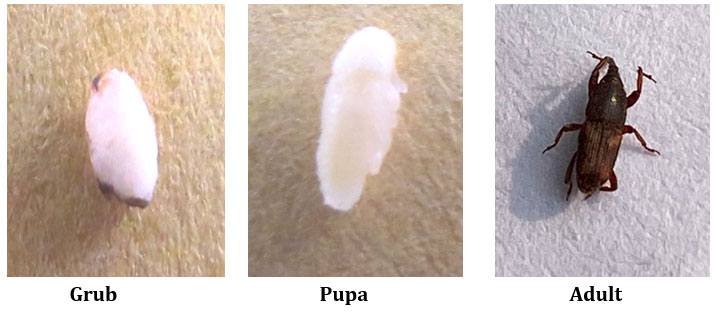
The adult is tiny weevil about 2.5 mm
long, dark brown or reddish brown in colour. Females lay about 150-300 eggs and
hatches in about 3 days. The grub is short, stout “C” shaped that is creamy-white,
curved, translucent, yellow or brown head with biting jaws. The larvae feed inside
the grain kernel for 18–20 days. The pupa is naked and the pupal stage lasts for 6-7
days. Adults live for 4-5 months. The new adult will remain in the seed for 3 to 4
days while it hardens and matures. The lifecycle is completed in 40–45 days.
Nature of Damage
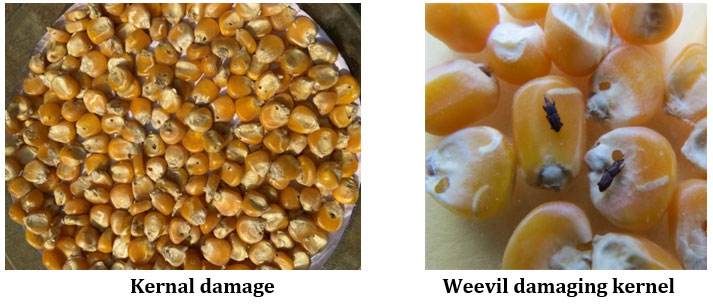
As it is an internal feeder, both adults and
larvae attack the grains and feed voraciously. In case of heavy infestation only
pericarp of the kernel is left behind, while rest of the mass is eaten up. The
insect can infest crop at maturing stage in the field or while storing.
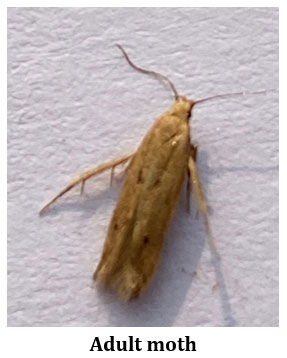
15. Angoumois grain moth Sitotroga cerealella (Olivier)
Features of Identification
Eggs are cylindrical, cigar – shaped
laid singly or in small clusters on the surface of the grain which look white at an
early stage but later changes to bright red. Caterpillar is white in colour with
yellow head. Larva undergoes 4 instars after about six days each at optimum
temperature. The adult moth measures 8-10 mm with buff coloured front wings. Hind
wings are margined with long hairs, their tips are elongated. The life cycle is
completed in 30-32 days.
Nature of Damage
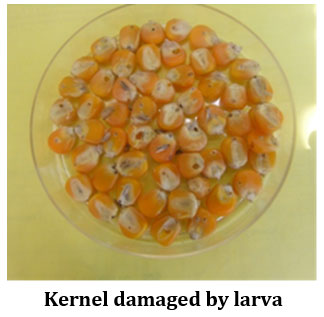
Only larvae damage grains, adults being
harmless. The larva after hatching, begins to feed on endosperm. As a result, grains
are hollowed out resulting into loss of viability. On damaged grains, a circular
hole with a characteristic flap or trap door appears. Pest attack is both in fields
and stores. In stored bulk grain, infestation remains confined to upper 30 cms depth
only.
Management strategies for storage pests
- Cleanliness and sanitation is the most important and first step towards prevention of insect infestation. Dusts, grain, and chaffs should be removed from transport system, storage area as well as threshing yard before using them for new produce after harvest.
- The crop should be harvested at theproper time to prevent egg laying by storage pests.
- The moisture content of grain should be less than 12%.
- Newer grains should not be mixed with older ones.
- Seed stored gunny bags should be kept few inches above the ground.
- 5% NSKE should be sprayed as a thin film on bags before use.
- Through mechanical devicesmonitoring and mass trapping (Probe traps) of stored product insects can be done
- Staggered sun drying with short exposure to sun spread reduces insect infestation
- By modified atmospheric storage, insects can be controlled by decreasing O2 or increasingCO2 or N2.
- Use of plant products such as Malabar nut-Adathodavasica, Neem-Azadirachtaindica, Five leaved Chaste Tree Vitexnegundo, Periwinkle Catharanthusroseus@ 2% w/w (20g /kg seed) have been found to be effective against storage pests.
- Storing of maize in double layered bags is advisable. Application of leaf powder of GuduchiTinosporacordifoliaas water-based paste between the layers of double layered storage bags provide protection against Sitophilusoryzaefor a period of five months
- Hermatic control (complete air tightness) is a simple, cheap and effective method of insect management. In this method metabolic activities of insects and microflora act as bio generators that alter the oxygen and carbon dioxide composition of the intergranular atmosphere so that insects development is arrested.
FAQ’s
- What are themajor pests of maize?
Stem borers, fall armyworm, shoot fly - Is there any new emerging pest problems in maize?
Yes. Fall armyworm (Spodoptera frugiperda) an invasive pest has become major pest in
maize. Helicoverpa armigera is an emerging pest in maize - What is the role of pheromone traps in maize?
The use of pheromone traps helps in monitoring the fall armyworm and regulating the
interventions for its management. - What is role of bio-pesticides in maize pest
management?
These are the safer and effective alternates for managing insect pests. - What is Tricho card and what is the purpose of using it in
maize?
Tricho cards are used for management of stem borers and FAW in maize crop. Parasitoid Trichogramma spp. parasitize the eggs of these pests, thus larvae fail to emerge from the eggs. - Can we apply insecticide along with Tricho-cards?
No. There is should be a minimum gap of seven days before and after application of
Tricho-cards. - What are the natural enemies found in maize?
Spiders, coccinellids, ear wigs, lace wings, dragon flies - What is IPM and how does it differ from farmers’
practices?
IPM is the integration of pest management tactics in compatible manner to keep the pest population below economic injury level without adversely affecting our environment. Farmers’ practices involve indiscriminate use of chemical insecticides which are available in the market without proper monitoring. - What are the possibilities of managing these pests other than
pesticides?
Cultural practices, host plant resistance based strategies and biocontrol. - Can hand picking of eggs or leaf infested with larvae facilitate the
control of pests.
Yes. Hand picking of eggs or leaves infested with larvae helps in managing the insectpests to some extent.

