Weed Management
Weed Management
Common weeds in maize and their control
A) Narrow leaf weeds
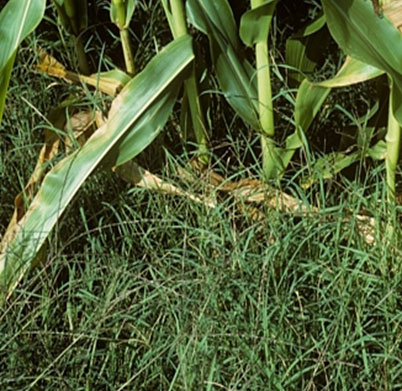
- Scientific name: Cynodon dactylon
Common name: Bermoda grass, Doob, Hariali, Duba
Description and identification
Nature: Perennial grass
Stem: Spreading type, bears under-ground rhizomes. The runners bears node and inter-nods and each produce root and short culm.
Leaves: Follow alternate-distal pattern, unhaired, 1-15 cm long, green to dull-green, lanceolate, finely parallel-ribbed, midrib absent; ligule very short
Propogation by: Rhizome and stolon
Season of occurrence: Round the year
- Scientific name: Cyperus rotundus
Common name: Nut grass, Purple nut sedge, Coco-grass, Java grass, Motha
Description and identification
Nature: Perennial sedge (20-60 cm tall)
Stem: Triangular cross-section, erect, smooth with swollen base
Leaves: Sprout in ranks of three from the base of the plant, leaf blades 5–20 cm long, 1-4.5 mm wide, grey-green or green, flat or folded, slightly keeled with distinct midrib; sheaths wide, acute, grey-brown or brown, sometimes with reddish tint
Inflorescence: Terminal, open umbel subtended by several leafy bracts, 2-6 cm long, reddish-brown to purplish-brown
Fruit: 3-angled achene, 1.5 mm long, dark brown or black
Season of occurrence: Round the year
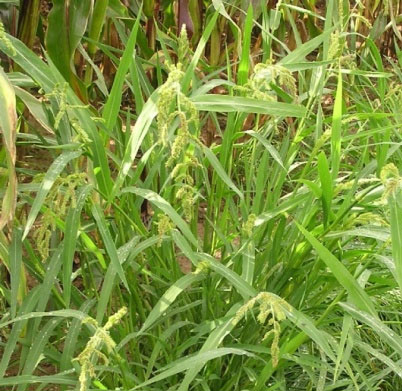
- Scientific name: Echinochloa colonum
Common name: Small burnyard grass, Jungle rice, Shama, Jharwa
Description and identification
Nature: Annual grass (20-60 cm tall)
Stem: Stout, erect, circular in cross-section, reddish-purple, 20-60 cm tall, nodes geniculated
Leaves: Light green, 5-30 cm long, 2-8 mm wide, glabrous, flat, purplish-tinged; leaf sheath 3-7 cm long, keeled, hairless; ligule absent
Flower: Panicle erect or nodding, green or purple-tinged, 5-15 cm long
Season of occurrence: Kharif
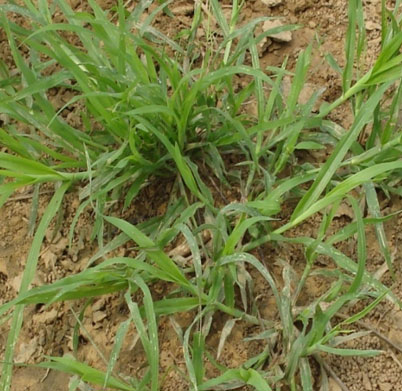
- Scientific name: Dactyloctenium aegyptium
Common name: Crowfoot Grass, Comb fringe grass, Four-finger grass, Makra
Description and identification
Nature: Spreading annual grass (up to 50 cm)
Stem: wiry and slender, produce root at the lower nodes; internodes cylindrical, glabrous, smooth; nodes thickened and glabrous
Leaves: Leaf-sheaths up to 5 cm long, keeled, tuberculately hairy on the keel; ligule membranous, about 1 mm long; leaf blades linear and flat when mature, up to 20 cm long and 12 mm wide, hairy along the margins and keeled
Inflorescence: ‘Bird’s foot’ digitate, produce at tip of stem, composed of 4-7 spikes, 1-6.2 cm long, 3-7 mm wide, greenish-yellow
Caryopsis: Sub-triangular or sub-quadrate, light-brown
Season of occurrence: Kharif
- Scientific name: Setaria glauca
Common name: Green Foxtail, Green bristlegrass
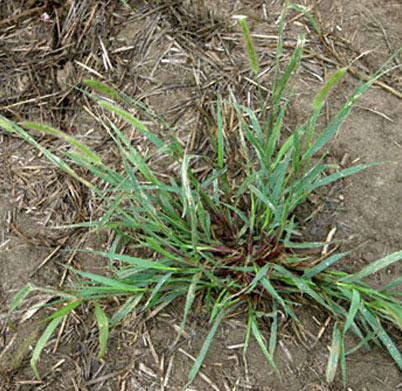
Description and identification
Nature: Annual grass ( up to100 cm height)
Stem: prostrate or erect, flat, frequently red base
Leaves: Leaf blades 40 cm long and 2.5 cm wide and glabrous, flat or v shaped,
Inflorescence: Compact, dense, cylindrical, upright, spike-like panicle, nearly 20 cm long; bristle turns yellow at maturity
Season of occurrence: Kharif
- Scientific name: Digitaria sanguinalis
Common name: Crabgrass, Finger-grass , Bamboo grass
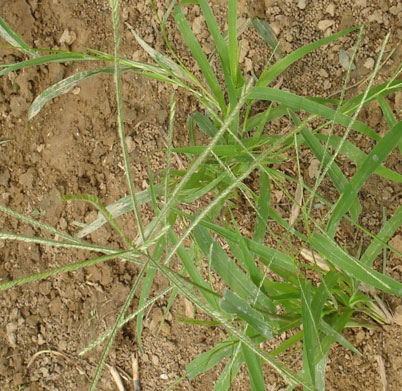
Description and identification
Nature: Annual herb
Stem: Prostrate, rooting at the lower nodes, distinctly bent at the lower nodes
Leaves: 5-15 cm long and 3-12 mm wide, green to purple with silky, shiny hairs; sheath green to reddish violet; ligule membranous white and 1-2 mm long, auricles absent
Inflorescence: 4-10 finger-like spike-like racemes, each 2-16 cm long, spikelets elliptic
Season of occurrence: Kharif
- Scientific name: Poa annua
Common name: Annual bluegrass
Description and identification
Nature: Short lived perennial grass (10-20 cm tall)
Stem: Slightly creeping, flattened
Leaves: Flat, soft, drooping, serrated edges, slightly keeled with characteristic ‘tramlines’, ‘boat-shaped tip’, transversely wrinkled, folded in the sheath; ligule 2-3 mm long and membranous
Flower: Open, triangular or ovate , 5 to 7.5 cm long
Season of occurrence: Kharif
- Scientific name: Phalaris minor
Common name: Little seed canary grass, Guli danda
Description and identification
Nature: Winter annual herb (up to 90 cm tall)
Stem: Erect, more-or-less slender
Leaves: Long, linear, acuminate; sheath smooth; ligule oblong, membranous and about 5 mm long
Flower: Panicle more-or-less protruding or entirely protruding from the uppermost
Season of occurrence: Rabi
B) Broad leaf weeds
- Scientific name: Parthenium hysterophorus
Common name: Carrot Grass, Congress grass, Gajar ghas, Chatak Chandani
Description and identification
Nature: Annual or short-lived perennial (up to two meter tall)
Stem: Erect, branched, become woody with age, longitudinally-grooved
Leaves: Pale green, branched and covered with soft fine hairs, deeply lobed, 8-20 cm in length and 4-8 cm in width
Flower: Terminal and auxiliary, white (4 mm across) have five distinct corners and grow on the stem tips
Seed: Flattened, black, 2 mm long, wedge shaped
Season of occurrence: Round the year
- Scientific name: Phyllanthus niruri
Common name: Carry me seed, Hazar dana, Bhui aonla, Jarmala, Jangli imli
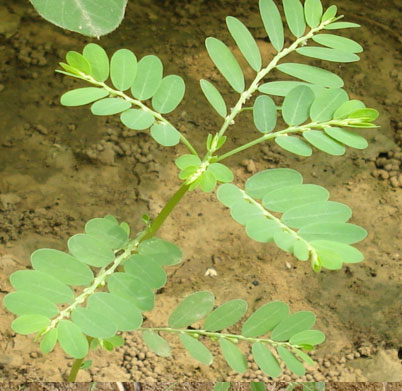
Description and identification
Nature: Small herb (30 cm tall) bears ascending branches
Leaf: Green, tiny, oblong-elliptic in shape
Flower: Tiny and yellow, born on lower side of leaves
Seed: Very small, round
Season of occurrence: Kharif
- Scientific name: Euphorbia hirta
Common name: Common spurge, Asthma weed, Bari dudhi
Description and identification
Nature: Perennial herb (60 cm tall)
Stem: Sparingly branched, cylindrical, reddish-purple. White colored liquid come out during squeezing
Leaf: Elliptical-oblong or oblong-lanceolate, bright green with serrated and purple margin
Flower: Purplish/greenish crowded cymes
Season of occurrence: Kharif
- Scientific name: Celosea argentea
Common name: Silver/white cock’s comb,Gadrya, Garkha
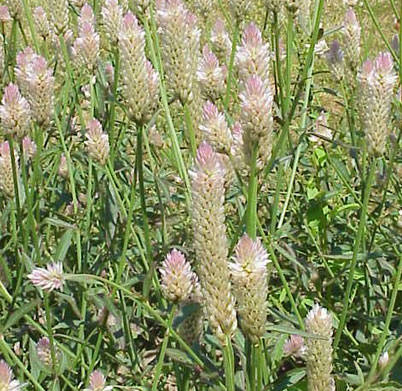
Description and identification
Nature: Annual herb (0.4-2 m tall)
Stem: Erect, branches strongly ridged and quite glabrous
Leaves: Narrow, large (5-15 cm), lanceolate-oblong, glabrous
Inflorescence: Silvery to pink colored, dense, conical or cylindrical in shape, located at end on the stem and branches
Season of occurrence: Kharif
- Scientific name: Portulaca oleracea
Common name: Purslane, Lunia
Description and identification
Nature: Annual or perennial herb (25 cm tall)
Stem: prostrate or erect, succulent, glabrous, green or purplish green
Leaves: Thick, fleshy, glabrous, glistening white underside, green or purplish-green above side, alternate, obovate-oblong to linear-oblong
Inflorescence: Cymose, yellow, clusters of 3-6 flowers subtended by 4-leaved involucres
Capsule: Many-seeded, 6-8 mm long, 3-4 mm in diam., contains shining black colored seeds
Season of occurrence: Kharif
- Scientific name: Amaranthus viridus
Common name: Green amaranthus, Pig weed, Jangali chaulai
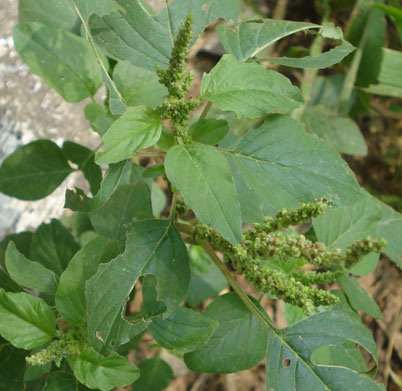
Description and identification
Nature: Annual herb (10-75 tall)
Stem: Erect, slender, sparingly to considerably branched, angular, channeled
Leaves: Glabrous, deltoid-ovate to rhomboid-oblong, long-petiolate (longer than lamina), narrow tip, dimension-2-7 x 1.5-5.5 cm
Flowers: Green, slender, auxiliary or terminal, often paniculate spikes, 2.5-12 cm long and 2-5 mm wide
Seed: Tiny, round, dark brown to black with an often paler thick border
Season of occurrence: Kharif
- Scientific name: Cleome viscosa
Common name: Asian yellow spider flower, Tick weed, Bagra
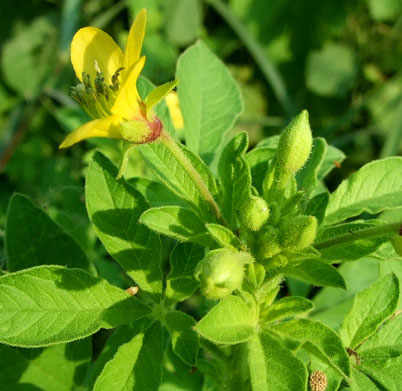
Description and identification
Nature: Annual herb (up to one meter tall)
Stem: Erect, green and hairy
Leaves: Compound leaves with 3-5-foliolate, petiolate (5 cm long); leaflets obovate, elliptic-oblong, variable in size (middle one largest), dimension: 2-4 cmX1.5-2.5 cm ,
Flowers: Whitish or yellowish, 10-15 mm diam.; pedicels 6-20 mm long
Fruit: Diam.-30-75 mmX3-5mm, linear-oblong, tapering at both ends, slender shaped
Seeds: 1-1.4 mm in diam., dark brown, have transverse ridges
Season of occurrence: Kharif
- Scientific name: Trianthema portulacastrum
Common name: Horse purslane, Giant pig weed, Sabuni, Vishakhapara
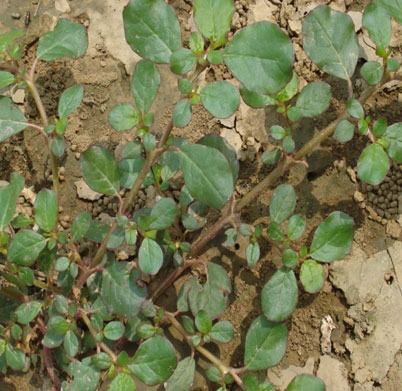
Description and identification
Nature: Annual herb
Stem: Form prostrate mat up to one meter long, succulent, sparsely velvety, green to red
Leaves: Flat, 1-2 cm long, elliptical to obovate or spade-shaped, base round or wedge-shaped; leaf stalk 0.5-2.5 cm long
Inflorescence: Born in leaf axils, solitary, stalk less, pink
Fruit: curved, cylindrical
Season of occurrence: Kharif
- Scientific name: Commelina benghalensis
Common name: Creeping dayflower, Kanshura
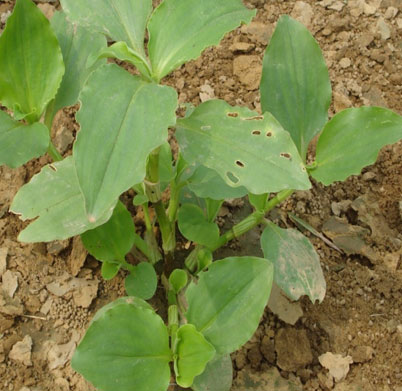
Description and identification
Nature: Perennial herb (20-60 cm long)
Stem: Succulent, green and creepy, branched from the base, rooting at nodes
Leaves: Ovate or elliptical, 2.5-7.5 cm long, 1.5-3.5 cm broad, sheathing base
Inflorescence: About 0.8-1.5 cm long, ovate-lance shaped, base sub heart-shaped, blue petals
Seeds: About 2 mm long, tuberculate and netveined, greyish-brown
Season of occurrence: Kharif
- Scientific name: Anaggalis arvensis
Common name: Blue pimpernel, Krishananeel, Neel, Dharti Dhak
Description and identification
Nature: Creeping annual (10-15 cm tall)
Stem: Creeping, not rooting at the nodes, square in outline
Leaves: Sessile, ovate-oblong, pale green, dimension:10-16 x 7-12 mm
Flowers: Solitary axiliary, red/pink or blue (or shades of them); pedicel 1.4-2.5 cm long, slender; yellow anthers
Seeds: Trigonal, 1 mm broad, dark brown
Season of occurrence: Rabi
- Scientific name: Chenopodium album
Common name: Lamb’s quarter, White goosefoot, Fat hen, Bathua
Description and identification
Nature: Winter annual herb (30-80 cm tall)
Stem: Upright, erect, branched towards apex, glabrous, furrowed, often with red or light-green streaks
Leaves: Alternate, simple ovate to rhomboid-oval, white with a mealy-covering, glabrous, densely covered with small hairs
Inflorescence: Born at the ends of the branches, 10-40 cm long, green
Seed: Circular in outline, oval in cross section, glossy, black, mean size 1.5 mm x 1.4 mm
Season of occurrence: Rabi
- Scientific name: Medicago denticulata
Common name: Bur Clover, Bur medic, Toothed medic
Description and identification
Nature: Winter annual herb (20-60 cm tall)
Leaves: Composed of three clover-like leaflets, inverted-egg shaped, wedge-shaped base, serrated edge
Flower: Cluster of 3-5 flowers, tiny, yellow
Pod (bur): Spiraled-coiled, 3.5–8 mm across, disk-like structure, contains prickles with hooked tips
Season of occurrence: Rabi
- Scientific name: Circium arvense
Common name: Creeping Thistle, Field Thistle, Canada Thistle
Description and identification
Nature: Perennial herb (30-150 cm tall)
Stem: Slender, green, freely branched
Leaves: Alternate, sessile, lobed, oblong, 15-20 cm long and 2-3 cm broad; margin pinnatel segmented and spiny
Flower: 1-2.2 cm in diam., pink-purple
Seed: Approximate 4-5 mm long, light brown, slightly curved, posses feathery pappus
Season of occurrence: Rabi
Control measures
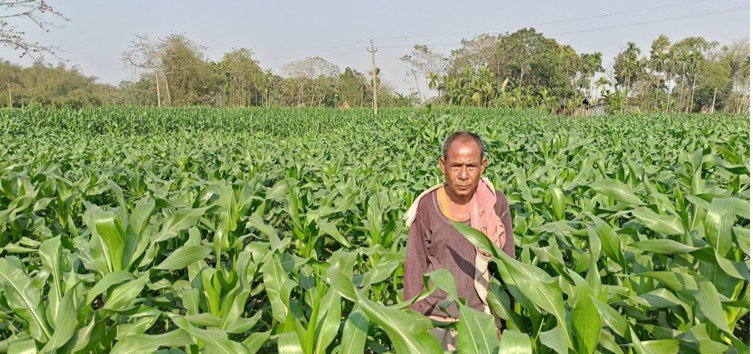
Weeds damage significantly to maize production and the critical period for crop-weed completion is 15-45 days after sowing.
Cultural control
a) Two manual hoeing at 15 and 30 DAS;
b) Inter-cropping of one or two rows of fodder cowpea in between maize rows reduces weed problem considerably.
Chemical control
Pre-emergence atrazine application followed by one hand weeding at 35-40 days gives good weed control. Recommended dose of atrazine at pre-emergence followed by either of the post-emergence herbicide for effective weed control (mentioned below) is also equally effective.
Selective herbicides for maize
| Herbicide | Formulations | Dose (g ai/acre) | Time of application (DAS) |
| Atrazine | 50 % WP | 300 | 0-2 |
| Topramezone | 33.6 % SC | 12 | 20-30 |
| Tembotrione | 34.4% SC | 50 | 20-30 |
The herbicides listed in above table are broad spectrum in nature hence effective against both narrow and broad leaf weeds in maize crop.
Integrated weed management: Pre-emergence atrazine application followed by one hand weeding at 35-40 days gives good weed control.

